Worthy aggregates fraud intelligence across every merchant on the platform. Before a bad actor enters the network, the case passes evidence review: confirmed chargebacks, confirmed fraud reports, and multi-signal correlation. Only verified threats propagate. The result is a network you can trust, with a false positive rate below five basis points.
Network
Performance

Network Performance

0.04% false positive rate

< 200ms signal propagation

Sharing fraud signals only works if every signal is real. Worthy refuses to propagate a block until the case clears evidence review. The numbers below reflect the network as it ran last month.
PRE-EMPTIVE BLOCKS · MONTHLY
0
K
Confirmed bad actors stopped across all merchants on the network
0
K
FALSE POSITIVE RATE
0.00
%
Disputed network blocks vs total network blocks, last 90 days
0.00
%
EVIDENCE REVIEWED
0
%
Every entry passes the inclusion pipeline before propagation
0
%


When a charge is flagged at one merchant, that flag stays local. The signal only propagates to the cross-merchant network after the case clears a four-stage evidence pipeline. Confirmed cases enter. Borderline cases stay local. False positives never reach another merchant.
01
Multi-signal correlation
The flagged charge must trigger at least three independent risk signals from different layers (card, device, IP, behavior, velocity).
Predictable Revenue Streams
02
Confirmed adverse outcome
The merchant must confirm the outcome: chargeback received, fraud report filed, or refund issued for confirmed unauthorized use.
Outcome verified
03
Risk team review
Cases that pass automated checks are reviewed by the Worthy risk operations team within four business hours. Manual sign-off is required.
Human in the loop
04
Network propagation
Only after the case clears all three prior stages does the signal propagate. Sub-200ms to every other merchant on the network, with a full audit trail.
Propagated to all


The network does not share one thing. It shares everything that helps the next merchant defend itself. Card history, device patterns, IP behavior, BIN performance, attack signatures, and cross-merchant velocity all flow through the same intelligence layer.
Every hashed card carries a network-wide score. Flagged at one merchant, scored low at every other. Score updates within two hundred milliseconds of any new event.
Browsers, mobile devices, and bots get a stable identity across every checkout. Devices banned for fraud at one merchant cannot transact at any other.
Every IP and IP range carries a reputation score derived from cross-merchant behavior. Datacenter ranges, residential proxies, and known abuse sources stay scored.
Collective approval rates, decline patterns, and fraud rates per BIN. Issuers and card products get evaluated on the aggregate of millions of transactions, not your own thin history.
When the network spots a new attack pattern, the signature gets distributed to every Autorisk endpoint. New fraud campaigns get recognized everywhere, not just where they first appeared.
One actor hitting many merchants in a short window is invisible to any single shop. The network sees the velocity in aggregate and blocks before the third or fourth merchant gets touched.

Blocked actors come
back under a different identity
Bad actors who get blocked do not give up. They come back with a new card, a fresh email, a different IP, even a new billing address. The trick: at least one identity attribute almost always stays the same. Worthy correlates every attempt across the full identity graph and keeps blocking, no matter how many surface attributes change.
Persistent attribute (matched across attempts)
Rotated attribute (changed by the actor)

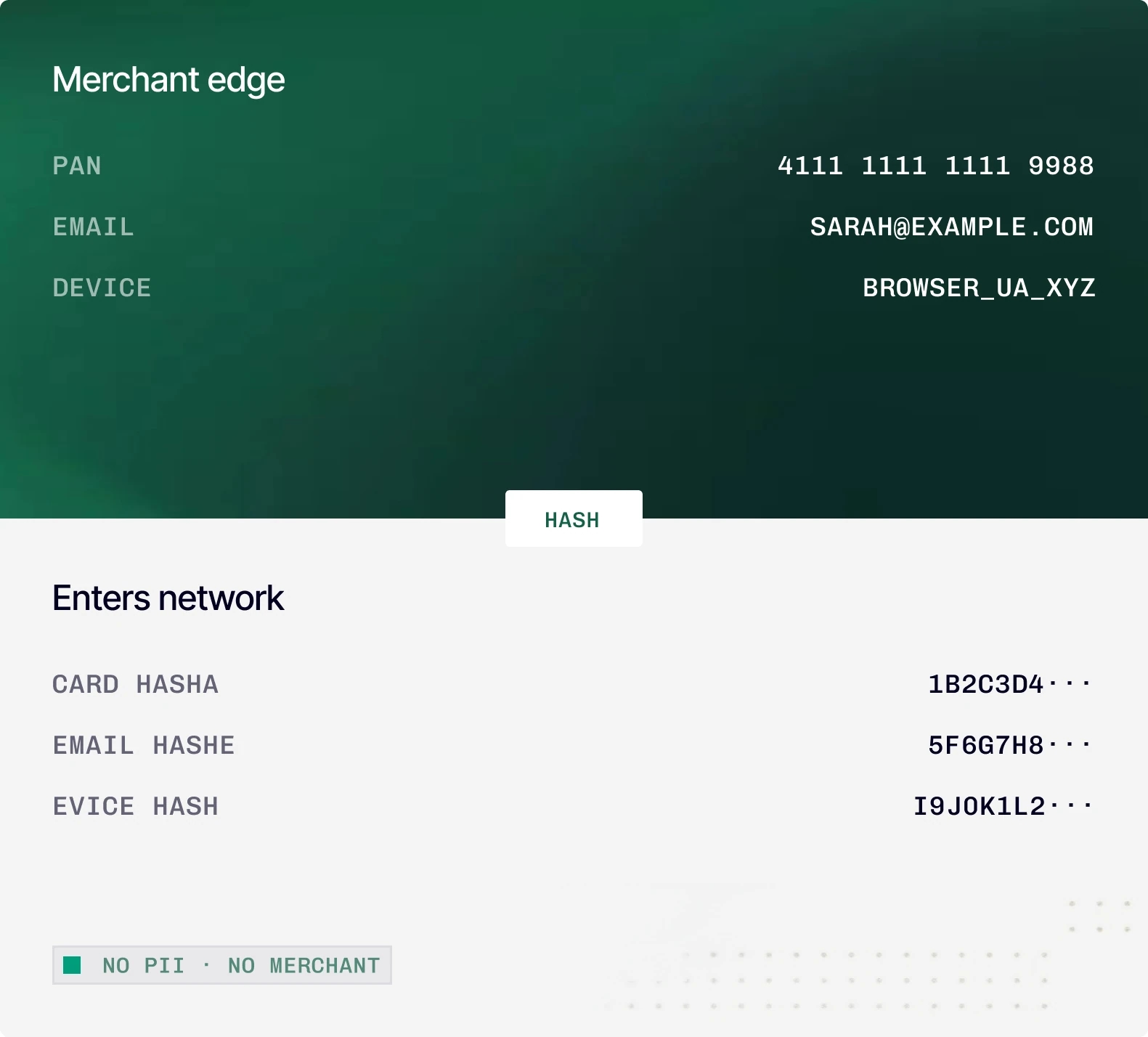
Sharing fraud intelligence does not mean sharing customer records. Every input to the network gets one-way hashed before it leaves the merchant. Worthy distributes risk scores derived from those hashes. No merchant ever receives another merchant's PII, charge details, or customer identities.
One-way hashing. Cards, devices, and emails get hashed at the merchant edge. The raw values never enter the network.
Merchant identity stripped. When the signal propagates, no other merchant can trace it back to the source.
No PII in transit. Names, addresses, and emails never traverse the network in any form.
GDPR and CCPA compliant. The architecture is reviewed against EU and California data regulations on every release.

See the network
protecting you in real time
The network dashboard shows every signal arriving from other merchants, every charge it blocked, and every fraud pattern it caught before it spread. Drill into any block to see how the signal reached you.

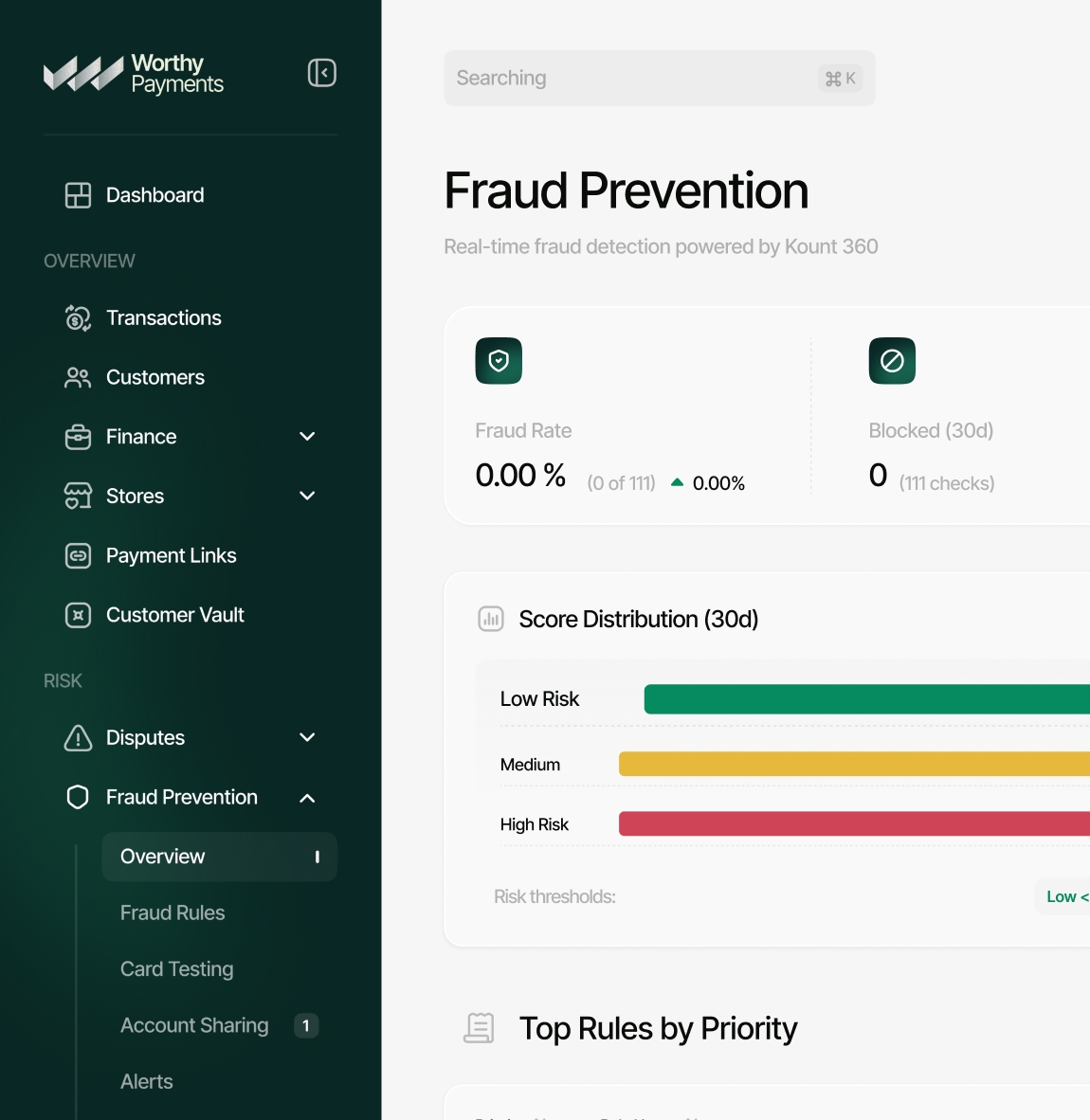

Every charge response surfaces the network score, the signal type that fired, and the propagation timestamp. Build alerts, audit trails, or custom logic on top.
The network_intelligence object surfaces every reason the network flagged the charge, plus the evidence trail and any identity rotation match.
verdict returns clear, monitor, or blocked depending on signal strength and evidence.
evidence_summary shows the inclusion pipeline outcome for this actor.
identity_rotation lists which persistent attributes matched a known bad actor.
propagation_ms shows how fast the original signal reached your endpoint.
// GET /v1/transactions/ch_6FA2B · RESPONSE

const response = {
	id: "ch_6FA2B",
	status: "succeeded",
	amount: 9900,
	cascade: {
		final_status: "recovered",
		total_ms: 312,
		attempts: [
			{
					processor: "processor_1",
					status: "declined",
					decline_code: "05",
					ms: 98
			},
			{
					processor: "processor_2",
					status: "declined",
					decline_code: "61",
					ms: 72
			},
			{
					processor: "processor_3",
					status: "succeeded",
					ms: 142
			}
		]
	}
};
Autorisk uses network signals on every charge. Velocity Rules apply network-wide thresholds across merchants. Network Tokenization carries the score through the token lifecycle. Account Sharing Detection reads identity rotation matches to flag shared accounts.

Composite ML scoring that reads network intelligence on every charge in under fifty milliseconds.
Confirmed bad actors at one merchant, blocked across every merchant. Identity rotation defense built in.
Cap repeat attempts by card, IP, device, or customer. Card testing defense uses the same engine.
Replace card numbers with tokens that survive reissues and carry the network score forward.
Apply for a Worthy account and connect to the Cross-Merchant Fraud Network. Every signal that protects you was evidence-reviewed before propagation, with identity rotation defense covering actors who try to come back. Talk to sales for a custom package or volume pricing.